

A note before you start.
This piece comes with a song. Same theme, different room. The song this week is called Afraid to Freestyle. It carries the most vulnerable line in the essay.
Read first and let the song land afterward. Or listen first and let the song open the door. Either order works.
Now, the piece.
Twenty-five feet
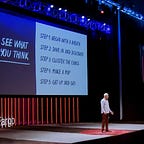
Summer 2018. I’m walking out to the red circle in Fargo. The walk is twenty-five feet. Four thousand people are waiting. The voice in my ear says “you’re on.”
I’ve produced over a hundred TEDx talks by this point. I’ve been backstage so many times the headset is muscle memory. I know what the lonely walk looks like from the wings. I’ve watched dozens of people make it.
I have never made it myself.
That’s the gap this essay is about.
What I didn’t know I didn’t know
I’d spent eight months getting ready. Four coaches: performance, writing, NLP, science. Over a hundred full run-throughs. Eight walks along the Santa Barbara coastline with Kymberlee that summer, finding the core idea one walk at a time. The slides done. The breath work done. The corrections made.
I knew what the architecture of a TEDx talk was supposed to look like because I’d been building it with other people for eight years.
Here’s what I found out on stage that I hadn’t found out in the wings.
Twice during the talk, for a millisecond, I froze. Kymberlee saw it from the audience. No one else did. The reps closed the gap so fast that what should have been a public moment became a private one. The architecture I’d built underneath the talk caught me before the audience could see me fall.
That’s what preparation actually does. It doesn’t make you fearless. It makes the fear invisible to everyone but the person who knows where to look.
I was afraid to freestyle.
I want to be honest about that. I’d drilled so deeply that the talk flowed. But on the most important stage of my speaking life, with the highest stakes I’d ever felt, I didn’t trust myself to deviate. The preparation was holding me, and that was enough. The spontaneity I’d written about, advocated for, helped other speakers find, I deliberately set aside that night. Because the cost of getting it wrong felt too high.
Preparation doesn’t make you fearless. It makes the fear invisible to everyone but the person who knows where to look. The bridge isn’t a guarantee. It’s a chance.
That’s worth saying out loud. The bridge isn’t a guarantee. It’s a chance.
Two camps, both wrong
Here’s the cultural fight underneath all of this.
Two camps. The systems people and the creative people. Each one looks at modern work and sees a different villain.
The systems people see chaos. Too much improvisation. Not enough process. Not enough rigor. They want more checklists, more frameworks, more SOPs, more architecture. Get the system right and the humans will function. Their fear is mess.
The creative people see cages. Too much process. Not enough room. Too many systems killing the soul. They want more freedom, more spontaneity, more permission to follow the work where it goes. Get the humans free and the magic will come. Their fear is suffocation.
Each camp diagnoses the other as the problem.
The argument has been running for decades. Neither side has won. Both sides have evidence. Both sides have stories. Both sides have produced real value and real damage.
The reason it’s still running is that both sides are wrong.
Systems alone don’t produce great work. They produce reliable mediocre work. Freedom alone doesn’t produce great work either. It produces unreliable brilliance and unreliable disaster in roughly equal measure.
The thing that consistently produces great work across every domain is the bridge.
What the bridge actually is
The bridge is the place where you’ve built the system AND you can deviate from it.
The chef has a recipe AND can taste the sauce and adjust. The musician has the chord chart AND can hear when the room wants a different turn. The pilot has the checklist AND can land in conditions the checklist didn’t anticipate. The doctor has the protocol AND can see when this patient isn’t the average patient.
Two skills. One performance. Neither one optional.
The trap each camp falls into is treating their preferred skill as the answer. Systems people think more system is the answer because they’ve never seen what happens when you have enough system to be free. Creative people think more freedom is the answer because they’ve never had the kind of architecture that makes freedom safe.
I had Father Tom in 1978. I was twenty-five, working in a Jesuit kitchen, lit up about something I had no idea how to pursue. He put his hand on my shoulder and said, “Mark, breathe. When you’re not sure how to move forward, start by making a list.” Then he walked me to the chalkboard where I drew the day’s menu, cleaned it off, and we started building the list. That list led me out of the kitchen and into a company called Wavefront. I’d be making versions of it for decades.
I didn’t know it then, but he handed me the bridge that morning. The kitchen menu was the system. The list was the system applied to something new. The freedom to call anyone I wanted, follow any thread, hit any dead end, was the spontaneity. The bridge was the table the menu lived on. Without the table, the menu is paper. Without the menu, the table is wood.
Picture the path, you’ll own the outcome. That’s the line I built a career on.
It still works because it holds both. Picture the path is the system. Own the outcome is the freedom. The two words people think are opposites are actually the same word said twice.
Why knowledge work refuses this
So here’s the question last week left hanging.
If this pattern is so consistent across every domain that survives pressure, why doesn’t most knowledge work look like this?
Two reasons.
First, the cost of failure in knowledge work is invisible until much later. A surgeon who refuses preparation kills someone today. A pilot who refuses preparation kills hundreds today. A senior leader who refuses preparation makes a strategic decision that costs the company a year, but the cost shows up next fiscal year, when the leader has moved on. The same failure pattern, different feedback loops. Knowledge work feels optional because consequences are slow.
Second, and this is the harder one, knowledge work culture mistakes the bridge for the camps.
The hustle myth says fast-and-spontaneous beats methodical. Move fast and break things. Ship and iterate. The reality is the opposite. The people who consistently ship at scale have more architecture, not less. They look fast because the prep happened earlier. They look spontaneous because the system underneath is invisible.
The opposite myth says rigor and process will save you. Add the framework. Document the SOP. Train the team. That works for execution but it doesn’t produce the kind of thinking the moment requires. The bridge needs both.
Some organizations have built the bridge. Pixar’s brain trust. The military’s after-action review. The best consulting firms. They exist. The question isn’t whether the bridge can exist in knowledge work. The question is whether you’re standing on one.
The question that follows
Once you see the bridge, the next question is personal.
What’s the bridge you’ve been building your whole life without noticing? What’s the through-line under your apparently scattered career? What’s the system underneath you that you keep refining, the one nobody told you to build?
That’s where we go next Saturday. Part 4 turns the camera around.
For this week, sit with the bridge.
Watch yourself work. Watch where you default to system when freedom is the move. Watch where you default to freedom when system would carry you. Watch the moment you cross from one to the other without thinking about it.
The crossing is the work. The crossing was always the work.
Build the table. Set the menu. Cook what the night asks for.
A note from Mark
This is Part 3 of the Preparation for Spontaneity series. We’re three quarters of the way through. The exhaustion was the diagnosis. The pattern was the answer. The bridge is the territory.
If you’re new this week, the short version is this. Most of what people call burnout is a system failure showing up as a feeling. The fix isn’t more effort. It’s building the preparation layer underneath the work, the way every domain that survives pressure has done forever. The bridge is where preparation and spontaneity stop being opposites and start being the same word said twice.
Next Saturday closes the series. Part 4 turns the camera around. The question for you is no longer what the bridge is. It’s what bridge you’ve been building all along without seeing it.
See you then.


