

You can listen to me read the piece, or continue and read at your own pace.
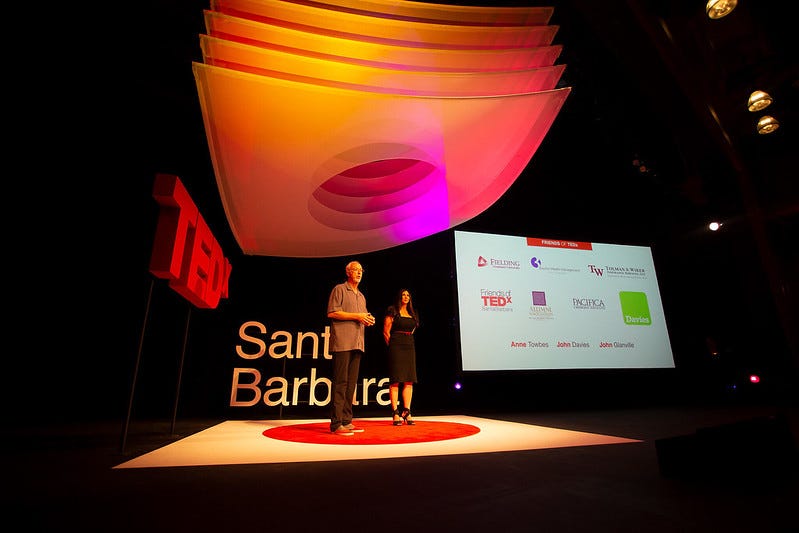
We're having dinner in SoHo—Kymberlee, Lee Daley, and me.
It's one of those long, delicious conversations that moves effortlessly from music to meaning to whatever comes next. Lee, as always, is dancing with language, throwing out phrases, testing ideas, and playing with possibility.
Now, Lee isn't just any friend. We met him back in Monterey in 2003, when TED was still this invitation-only enclave—you had to be invited to attend, and you could have conversations with the most interesting people because everyone was 'somebody.' The audience was as curated as the speakers. We'd just debuted IntroNetworks there—this patent-matching engine that connected the TED community.
Lee fell in love with it immediately.
See, Lee was the Chief Strategy Officer at a massive advertising agency with 18,000 employees scattered across the globe, and he had a vision for how our software could connect them all. That's how his brain worked—always seeing patterns, always thinking three steps ahead.
Through that work and all those trips to New York City, the three of us developed this incredible friendship. And because Lee knew how deeply we'd been involved with TED over the years, working directly with Chris to develop IntroNetworks, when we mentioned we were thinking about organizing a TEDx... [PAUSE] his marketing brain just kicked into high gear.
Lee stops mid-conversation, leans in, and asks, "Do you have a date?"
We shake our heads. Not yet.
He smiles that Lee smile.
"You know," he says, "10/10/10 only happens once."
There's this moment where everyone at the table knows something just shifted.
Kymberlee and I look at each other. That's it. That's the date.
“Yeah. October 10th, 2010. That gives us a year to produce the show.”
Right there, between bites of something wonderful and the hum of SoHo at night, we pick our moment.
That spark? That was the beginning.
Where It All Started
Let me take you back a little further.
To those early days of attending TED in Monterey, then Long Beach, then Vancouver. We weren't just watching talks. We were immersed in something carefully, artfully built.
The richness of production. The choreography of curation. The intention behind every element:
Lighting
Pacing
Set design
Music
Meals
The placement of every single chair
It was all storytelling.
And if you dig up some of those early TED talks online, you can actually see our faces in the audience, eyes broad, hearts lit up.
TED wasn't a conference. It was an experience. And we kept thinking:
What would it look like to bring that feeling—that level of care, of wonder, of design—home to Santa Barbara?
That question stayed with us. The spark that led us to the table in SoHo. The moment that turned into a movement.
The Real Job
For years, when people asked what I did as Executive Producer, I gave the usual answer:
I'm involved in everything. The theme, curation, run of show, volunteers, venue, lighting cues, chair layout, sound check, and snacks. My fingerprints were on every detail.
But over time, I realized that wasn't quite it.
The real job? Reducing friction. At every touchpoint. For everyone involved.
And you know what? That philosophy has become my guiding principle for how I show up everywhere now. At work, at play, in anything I do. I'm always thinking about the other people, whether I'm working with them or playing with them.
Are they doing okay? Have I removed all the barriers to productivity, to fun, to effectiveness?
We run an improv comedy school on Tuesday nights, and I think about this constantly. People come in from their busy lives, and my job as executive producer is to ensure they can park all the email and drama of life and just have fun.
Having people show up and have an experience, whatever it is, big or small, where every moment matters? That's a really big deal for me.
But back to TEDx.
For the speakers, reducing friction means making space for their brilliance without overwhelming their already full lives. It’s about building sustainable rituals—small, steady rhythms for writing, revising, and rehearsing—that let their ideas rise naturally. And that’s where Kymberlee comes in.
She’s been the dedicated coach for every TEDxSantaBarbara speaker since 2010. She doesn’t just help them prepare; she holds space, protects their vision, and walks with them every step of the way. Kymberlee has developed an entire methodology to uncover and shape each speaker’s core idea—and she’s the one crafting those sustainable rhythms that carry them all the way to the red circle.
By the time they step into that red circle:
There's a green room with their favorite tea
A vegan snack if they need it
A quiet corner or a warm circle, depending on what grounds them best
There's been a full dress rehearsal, a tech run
A well-lit space that asks for presence, not perfection
We always did more than one rehearsal. One early, then a full dress. Because something always happens. A mic dies. A light flickers. One year, our lighting director got stranded out of town. But we had that dress rehearsal captured digitally from multiple cameras. That talk made it to the stage because we had the foresight to treat every run like it counted.
Reducing friction means thinking ahead—so when it's showtime, nothing pulls the speaker away from their moment.
For the Audience
Friction is anything that yanks them out of the experience. So we designed every beat:
The ticketing process
The welcome
The temperature in the room
The way light catches the stage
The fact that someone looked up, smiled, and said, "We're so glad you're here."
Because when that speaker steps up to give the talk of their life, I want the audience leaning in—not distracted, not uncomfortable, not trying to decode a program or hunt for coffee.
Fully there.
For the Team
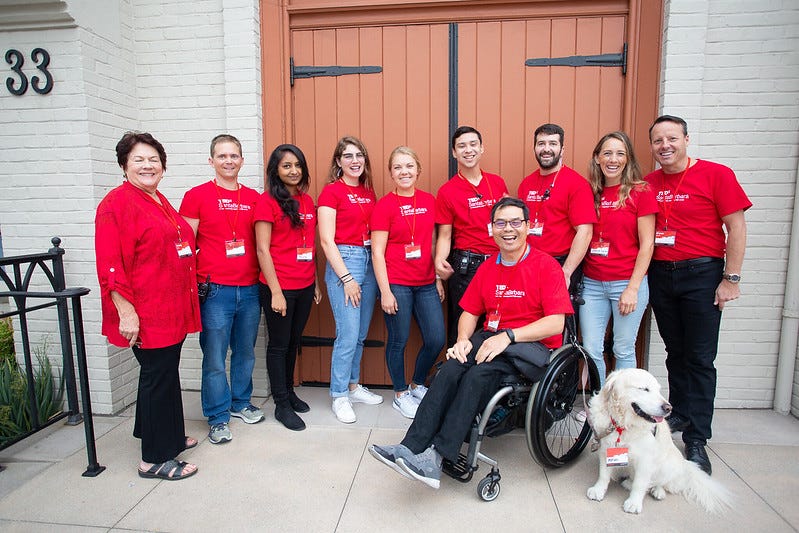
Our 10-person core, the 50-plus volunteers who showed up week-of, and the day-of crew who brought everything to life—reducing friction meant:
Clear roles
Clean communication
Fostering a culture where everyone knew what they were doing and felt great doing it
We built systems that disappear. That's the goal.
By showtime, I won't be scrambling. I'm not solving last-minute chaos. I'm outside, talking to people in line, asking how they're doing, like I've got nothing else to do.
That's the point.
When Everything Goes Wrong
Let me tell you about the moment that taught me everything about turning constraints into magic.
It's 2019. Our last live show before the pandemic. Two days before the event, the venue we'd booked for our speaker dinner fell through. Not our fault. Just gone.
Now I've got 14 speakers, each with a guest, and no place to feed them or host the community we love.
Here's the thing about problems like this—if there's no struggle, there's no story. But more importantly, this is my problem to solve. The moment I make it anybody else's problem, they're going to absorb that tension and drama. People want to be helpful, so they'll start asking, "What are we gonna do? What are we gonna do?"
And all of that is friction-inducing. I'm not having any of that.
That's what producers do. We solve problems. Design is solving problems. So I started thinking like a designer:
How do we optimize this? How do we turn this constraint into something better?
And that's when I realized what this could become—a chance to truly celebrate the speakers and thank their loved ones for supporting them through this journey.
The Stage Becomes the Table
We moved the dinner to the stage.
The Victoria Theatre was already dressed to open at 9 the next morning. I called in tables, covered them in linens, and sent someone to buy a hundred battery-powered candles. We didn't use the house lights. Just warmth. Just glow.
That night, our speakers walked in expecting a backup plan. Instead, they found the very stage where they'd stand tomorrow, transformed into a long table for storytelling and shared plates.
A young chef from Santa Ynez pulled up with his wood-fired pizza oven, telling stories while the crust blistered. We talked. We looked out at those empty seats that would be filled tomorrow.
One speaker was twelve years old—Jude Kadi. His father had spoken on our stage a couple of years earlier—a Syrian director who risked everything to tell stories when cameras were forbidden. And now the son sat beside him, about to speak his own truth.
We didn't plan that moment. We just made space for it.
After the show the next night, we spilled into the atrium, music echoing into the streets of downtown Santa Barbara. It wasn't perfect. It was better. It was ours.
The Hundredth Speaker
Over the years, we produced exactly 100 live talks. Some went viral. Some landed locally. Some took years to find their audience. But every single one mattered.
After that, I moved to doing virtual shows and produced 175 interviews for TEDxSantaBarbara Salon: Making Waves, conversations with Influencers and Disruptors. That show ran until last December.
And I know when people read this story, they're going to ask: when is TEDx coming back to Santa Barbara?
The answer is that we're hosting salons at the Santa Barbara Public Library Foundation, and we're going to explore sustainability and longevity in two curated sessions that I'm very excited about. People should visit TEDxSantaBarbara.com to ensure they receive notifications and are added to our list.
That last show in 2019—our closer was Lieutenant Colonel Scott Mann, who'd spoken with us before but was back to update his talk. What he didn't know, what I hadn't told him, was that he was our 100th speaker.
I didn't want to add pressure. That's not his burden. That's mine.
My job is to hold the weight so others can stand light.
He delivered. Of course he did. And after, I told him: you were number 100.
He nodded. Quiet. Grateful. It was the perfect close.
What We Really Built
We didn't just produce events. We created conditions for transformation. And then we stood back and watched the room lean in.
Speakers told us their TEDx experience was a milestone. What they learned about storytelling stayed with them. That something in them shifted.
And that means everything.
If you're wondering what your job really is, wherever you are, it's this: Reduce the friction. Raise the bar. Make space for someone else's idea to shine.
Every talk begins with a spark. Our job was to clear the path, light the candles, and get out of the way.
Coming Full Circle
In the end, it's just the two of us. Driving home in the dark after that final show.
This is our ritual. After every retreat, workshop, performance, presentation, or keynote, we show up fully to these things we love. There's all the activity, energy, and wonderful chaos, and then we get in the car, and all of that quiets down.
We look at each other and say: "That's it."
It's not relief—we love what we're doing. It's satisfaction. We did a good job.
And then, after that brief moment of completion, we naturally shift into what Lieutenant Colonel Scott Mann taught us. In the military, they call it an after-action review. We call it the three W's: What went well? What went wrong? What needs work?
We're very intentional about this. When we get ready to do the next event, we pull that review out and go over it. Typically, there's maybe one or two things that went wrong—we've gotten it down to where it's only one or two things. But "what needs work" is where we spend our time, making sure we correct it next time.
We only give ourselves a beat to reflect—"Hey, that's it, we're done"—and that's become kind of a signature thing for us. Just the two of us. "Yeah, that's it." And then in almost the next breath: What went well? What needs work?
That's how every journey ends and begins again.
What friction could you design away in your own life? What conditions could you create for others to shine? I'd love to hear your thoughts—reply and tell me about a time when removing barriers made all the difference.
reduce friction. of course.
Such a beautiful TED/TEDx journey. I still remember being in the audience at TEDxSantaBarbara in 2016 — a masterful production by you and Kymberlee.